Deep Plane Facelift in Korea: Procedure Overview, Recovery, and General Considerations
Facial aging does not simply mean that the skin becomes loose. Over time, multiple layers are affected together, including the skin, subcutaneous fat, SMAS (Superficial Musculoaponeurotic System), deep tissues, and even the facial skeleton. As a result, facial volume shifts downward, and nasolabial folds and jawline sagging become more noticeable.
When international patients research facial rejuvenation treatments or facelift surgery in Korea, they often come across terms such as dual plane, deep plane, and extended deep plane. These techniques all involve the SMAS layer, but they differ in the depth of dissection, the extent of retaining ligament release, and whether the lift extends to the neck.
A deep plane facelift in Korea is often considered by patients who want a natural-looking, longer-lasting result rather than an overly pulled appearance. However, it is not automatically the best option for everyone. The most suitable facelift technique depends on the patient’s facial anatomy, skin quality, aging pattern, neck condition, and the surgeon’s assessment.
At MEDIPACT, we help international patients clearly understand their options before making surgical decisions. In this article, we explain what dual plane, deep plane, and extended deep plane facelifts are, how they differ, what the recovery process may look like, and what patients should consider when planning facelift surgery in Korea.
1. What Is a Deep Plane Facelift?
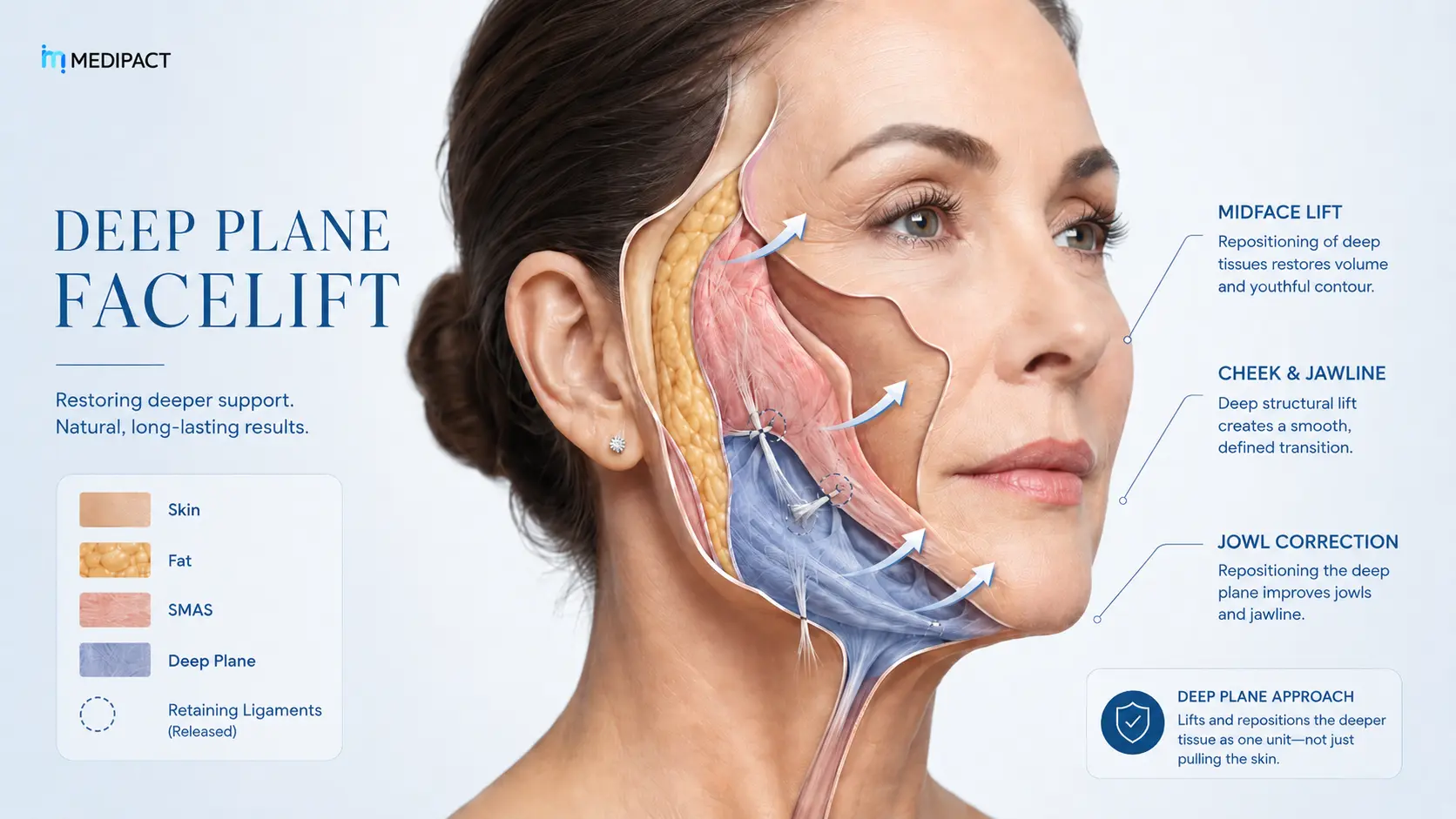
A deep plane facelift is a facelift technique performed beneath the SMAS, or Superficial Musculoaponeurotic System. The SMAS is a fibromuscular layer located under the skin and subcutaneous fat. In many conventional facelift techniques, the skin and SMAS layer are lifted or tightened separately. In contrast, the deep plane approach works through a deeper anatomical layer and releases selected retaining ligaments that anchor descended facial tissue.
This allows the tissues around the cheeks, lower face, and jawline to be repositioned more structurally. The goal is not simply to pull the skin tightly, but to restore facial support by lifting the descended cheek fat pad and deeper soft tissues closer to their original position. This can help create a more natural result that appears less dependent on skin tension.
This is why a deep plane facelift is often described as creating a more “rested” appearance or a more three-dimensional restoration. However, the outcome can vary significantly depending on the surgeon’s skill, the patient’s facial anatomy, skin condition, healing process, and whether the procedure is truly appropriate for the patient.
2. Dual Plane Facelift vs. Deep Plane Facelift vs. Extended Deep Plane Facelift
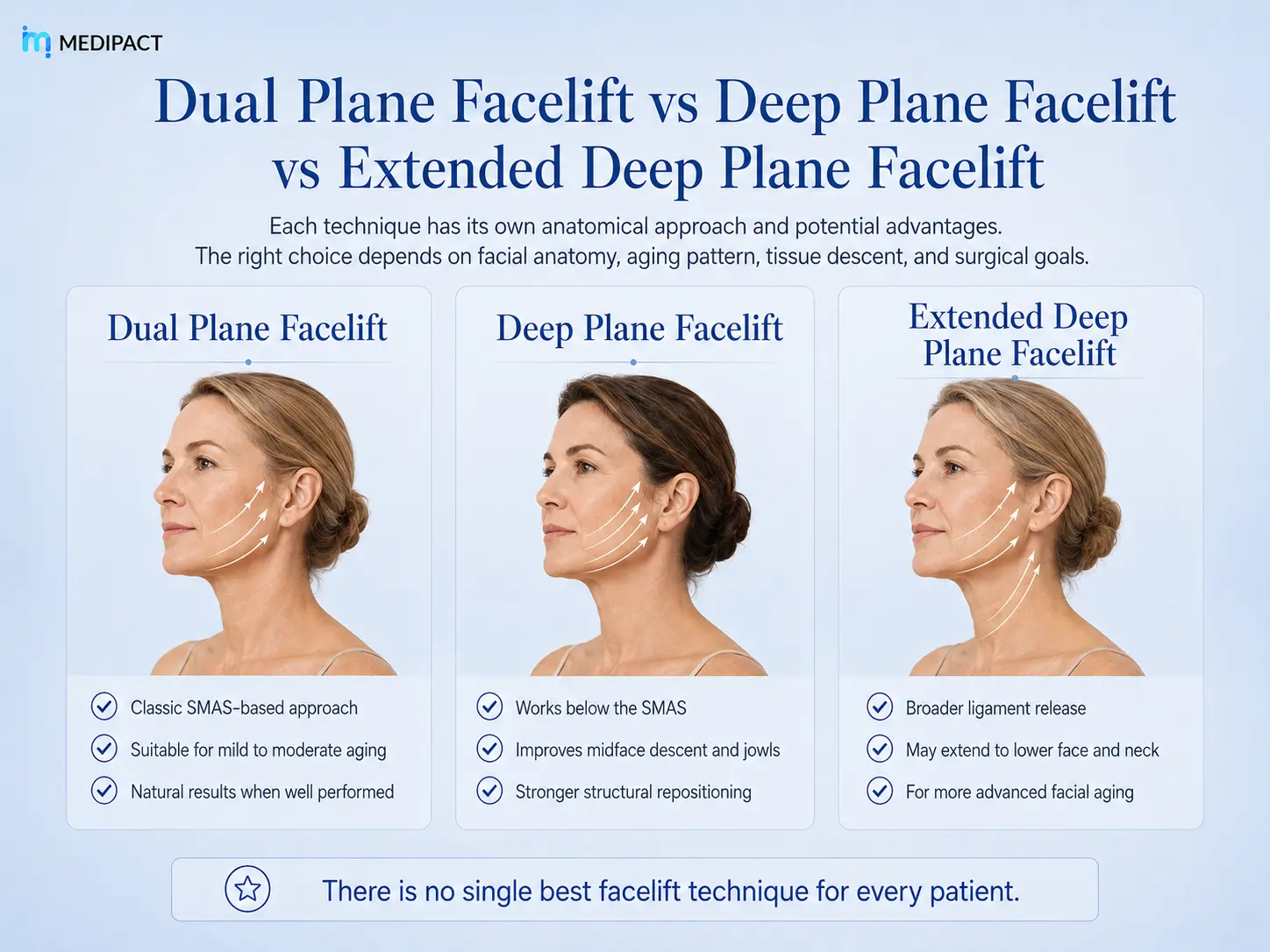
Dual plane facelift, deep plane facelift, and extended deep plane facelift are representative techniques in modern facelift surgery. Each approach has its own anatomical method and potential advantages. However, it is important not to assume that one technique is automatically superior to the others. In facelift surgery, there is no single “best” method that applies to every patient.
The key to a successful facelift lies in the surgeon’s anatomical understanding, clinical experience, and ability to choose the right technique for each patient’s facial structure. When performed accurately by a highly experienced specialist, any of these facelift techniques can produce effective, refined, and natural-looking results.
To select the most suitable surgical method, a detailed medical assessment should first be performed. This includes evaluating the depth of facial tissue descent, skin elasticity, midface volume, jawline sagging, neck laxity, facial asymmetry, and the patient’s overall goals.
Below, we explain the main characteristics of each facelift technique and how they may differ.
Category | Dual Plane | Deep Plane | Extended Deep Plane |
Dissection layer | Separates two layers: the skin–SMAS layer and the SMAS–deep tissue layer | Dissects in the sub-SMAS layer beneath the SMAS, moving the skin and SMAS together as one unit | Extends the deep plane technique to the midface and neck |
Retaining ligament release | Partial release | Release of the main facial retaining ligaments | Selective and broader release of the zygomatic, masseteric, mandibular, and cervical retaining ligaments |
Degree of adjustment | Allows the skin and SMAS to be adjusted in separate directions | Moves the tissue as one unified composite flap | Repositions the face and neck as one integrated structure |
Suitable for | Patients with uneven sagging in different facial areas or those who need more delicate, area-specific adjustment | Patients with midface descent, deep nasolabial folds, and those who want a natural-looking result | Patients with moderate to significant sagging involving the neck, marionette lines, deep cheek area, jawline, and lower face |
Approximate recovery period | Social recovery in around 2–3 weeks | Social recovery in around 3–4 weeks | Social recovery in around 3–4 weeks |
Result style | A refined look with delicate correction of area-specific sagging | A three-dimensional result with restored midface volume | Integrated improvement of the face–neck line and the most comprehensive contour refinement |
In facelift surgery, the most important factor is not the specific “procedure name,” but the accuracy of the anatomical approach. The outcome largely depends on how precisely the surgeon determines which tissue layers should be treated and which retaining ligaments should be released during surgery.
Lifting techniques such as deep plane and dual plane facelift should be selected and applied flexibly based on the patient’s facial skeleton, SMAS layer, and skin condition. This customized approach, based on a thorough understanding of the individual facial structure, is essential for achieving the most natural lifting effect while avoiding an artificial or overdone appearance.
3. Who Is a Good Candidate, and What Can It Improve?
Both deep plane facelift and extended deep plane facelift are generally suitable for patients with moderate to significant facial aging, especially when the deeper facial tissues have started to descend. The main difference between the two techniques is the treatment area, so the right choice depends on where the sagging is most noticeable.
- When a Deep Plane Facelift May Be Suitable
A deep plane facelift may be considered when the main concern is sagging in the midface and lower face. It may be suitable for patients with:
Sagging of the cheeks or deep cheek area
Deepened nasolabial folds
Jowling around the jawline
Loss of jawline definition
A heavy-looking lower face
Downturned mouth corners
Because the deep plane technique repositions deeper facial tissue, it may also help restore midface volume more naturally by lifting and repositioning the descended cheek fat.
- When an Extended Deep Plane Facelift May Be More Suitable
An extended deep plane facelift may be recommended when neck sagging is also present in addition to the typical concerns treated by a deep plane facelift. It may be more suitable for patients with:
Sagging under the chin
Loss of double-chin and lower-face contour definition
Neck wrinkles or platysma muscle laxity
A blurred jawline where the jaw and neck boundary is no longer clear
When neck laxity is already noticeable, an extended deep plane approach may be more appropriate from the beginning because it allows the face and neck to be addressed more comprehensively.
Age Is Not the Only Standard!
Most facelift patients are commonly in their mid-40s to 70s, but age alone should not determine candidacy. Some younger patients may be suitable candidates if they have structural sagging after facial contouring surgery, weight loss, or natural tissue descent. On the other hand, some older patients may benefit more safely from a smaller procedure depending on their skin quality, health condition, and recovery capacity.
This is why MEDIPACT encourages patients to start with a full-face assessment rather than focusing only on a specific procedure name. A proper consultation should evaluate skin condition, facial fat distribution, bone support, asymmetry, neck laxity, the eye area, and a realistic recovery timeline before deciding whether a deep plane facelift or extended deep plane facelift is the right choice.
4. Facelift Recovery Timeline
Facelift recovery timeline varies from patient to patient, but international patients need to plan especially carefully. The early recovery period is different from the full healing process. Many patients may look socially presentable after a few weeks, but it can take several months for the deeper tissues to fully settle.

Recovery Stage | Expected Changes |
Days 1–3 | Swelling, tightness, bruising, pressure sensation, possible drains, and close monitoring by the clinic |
Days 4–7 | Swelling may become more noticeable from around Day 3, and the first follow-up appointment is often scheduled during this period |
Days 10–14 | Bruising gradually improves, but swelling may still remain. Suture removal and follow-up checks are often performed during this stage |
Weeks 2–3 | Many patients can return to light daily activities or desk work, although the face may still feel firm or appear swollen |
Weeks 3–4 | Many patients can return more comfortably to social activities, but residual swelling and tightness may remain |
Months 2–3 | Redness and firmness begin to soften, while the healing and scar maturation process continues |
Months 3–6 | Residual swelling and tissue firmness continue to improve, and the result starts to look more natural |
Months 6–12 | Final contour refinement, scar maturation, and tissue settling continue |
For international patients, it is generally recommended to stay in Korea for at least 10–14 days so the clinic can check the healing progress, remove sutures, and manage any early concerns. Since swelling gradually improves over time after surgery, it is best to avoid scheduling important events or photoshoots too soon after the procedure.
5. Risks and Key Considerations
A deep plane facelift or extended deep plane facelift is not a minor cosmetic procedure. Possible risks may include hematoma, infection, delayed wound healing, temporary numbness, temporary facial weakness, scarring, asymmetry, hairline changes, and the possibility of revision surgery.
Facial nerve injury is rare when the procedure is performed by an experienced surgeon, but it remains one of the key reasons why this surgery should be performed by a specialist with advanced knowledge of facial anatomy and extensive facelift experience. Because deep plane facelift techniques involve deeper tissue layers, choosing the right surgeon is especially important.
It is also important to understand that the term “deep plane facelift” is not used in exactly the same way by every clinic. Even when the same term is used, the extent of dissection, lifting vector, retaining ligament release, and fixation method may vary depending on the surgeon. During consultation, patients should ask how the surgery will actually be performed, rather than relying only on the procedure name.
6. Planning a Deep Plane Facelift in Korea
Many international patients consider facelift surgery in Korea because Korea has a highly developed aesthetic surgery market, a wide range of facial lifting and anti-aging treatments, and many clinics with experience treating international patients. However, the right clinic is not simply the most famous one or the one with the most advertising.
Before choosing a clinic, patients should check the following:
Whether the surgeon is properly qualified, including board certification in plastic surgery and experience with facelift cases
Whether the doctor who provides the consultation will personally perform the surgery
Whether the clinic has proper anesthesia and safety systems in place
Whether post-operative follow-up care is clearly included
Whether English or multilingual communication is available
Whether the recommended facelift technique matches the patient’s facial anatomy
Whether before-and-after photos show natural-looking results on patients with similar facial features
Whether the quote includes anesthesia, medication, follow-up visits, compression garments, and revision policy details
The cost of a deep plane facelift in Korea can vary depending on the surgeon, clinic level, anesthesia method, surgical complexity, and whether the procedure is combined with a neck lift, fat grafting, eyelid surgery, brow lift, or laser treatment. Patients should not compare only the lowest surgery price. This is especially important for international patients, who should confirm exactly what is included in the total quote before planning travel.

Through MEDIPACT, patients receive support in comparing clinic options, understanding consultation feedback, preparing questions, and organizing the medical journey from consultation to recovery care. The goal is not to recommend the most complex procedure, but to help each patient choose the safest and most suitable plan for their face.
During consultation, patients may want to ask:
Am I a better candidate for a dual plane facelift, deep plane facelift, or extended deep plane facelift?
Which areas of my face need structural lifting?
Do I also need a neck lift? For extended deep plane facelift, does the plan include the neck area?
Which retaining ligaments will be released during surgery?
Where will the incisions be placed?
How will you avoid an overly pulled or artificial appearance?
How long should I stay in Korea before flying home?
What warning signs or complications should I watch for after returning home?
A trustworthy consultation should not simply recommend the most expensive or most advanced-sounding procedure. It should clearly explain why a specific facelift technique is suitable for the patient’s facial anatomy, aging pattern, and recovery goals.
Frequently Asked Questions
How long do deep plane facelift results last?
Many surgeons describe deep plane facelift results as long-lasting, and some may refer to results lasting 10 years or more. However, no facelift result is permanent. Genetics, skin quality, weight changes, smoking, sun exposure, and surgical technique can all affect how long the results last. Facial aging continues even after surgery.
Which is best: dual plane, deep plane, or extended deep plane facelift?
There is no single best facelift technique for every patient. If the degree of sagging differs by facial area and delicate adjustment is needed, a dual plane facelift may be suitable. If midface descent and deep nasolabial folds are the main concerns, a deep plane facelift may be more appropriate. If neck sagging and loss of definition between the jawline and neck are also present, an extended deep plane facelift may be a better option.
The right choice should be based on facial anatomy and aging pattern, not trends.
How long is facelift recovery?
Most patients need around 2–4 weeks before returning to early social activities. A dual plane facelift may have a relatively shorter early recovery period, often around 2–3 weeks. Deep plane and extended deep plane facelift recovery usually takes around 3–4 weeks or more for early social recovery.
Swelling and tissue settling continue for several months, and final results may take 6–12 months to fully appear.
Can a facelift be combined with a neck lift?
Yes. If there is neck sagging, platysmal banding, or loss of definition between the jawline and neck, a facelift and neck lift are often performed together.
An extended deep plane facelift often addresses the face and neck as one connected structure, so a separate neck lift may not always be necessary. With a dual plane facelift or deep plane facelift, whether a neck lift should be added depends on the degree of neck laxity. The best combination should be decided by a specialist after evaluating the patient’s anatomy.
How long should international patients stay in Korea after facelift surgery?
International patients are generally advised to stay in Korea for at least 10–14 days for early recovery, follow-up checks, and suture removal. For wider-dissection procedures such as an extended deep plane facelift, staying 14 days or longer may be recommended when possible, as swelling and tissue stabilization can take more time.
MEDIPACT can help coordinate the patient’s recovery timeline with the clinic’s follow-up schedule and travel plans.
Conclusion: Choose the Right Facelift for Your Face, Not the Trendiest Name
Dual plane facelift, deep plane facelift, and extended deep plane facelift can all produce good results when performed properly. However, the same technique is not right for every patient. An extended deep plane facelift may be excessive for someone who mainly needs delicate area-specific adjustment, while a standard deep plane facelift alone may not be enough for someone with significant neck sagging.
What matters most is not how advanced the procedure name sounds. The important questions are:
Can the surgeon clearly explain your facial anatomy?
Does the consultation compare all three options honestly?
Is the recommended technique truly suitable for your face?
Is there a safe and realistic recovery plan?
Is clear aftercare available for international patients?
MEDIPACT helps international patients prepare for facelift surgery in Korea with clinic matching, consultation support, translation, scheduling, and recovery coordination. Our goal is not to recommend one specific procedure, but to help each patient find the safest and most suitable treatment plan for their face.
Not sure which facelift technique is right for you?
Read our full guide to facelift surgery in Korea to compare different lifting options, consultation points, recovery planning, and what international patients should consider before choosing a clinic.
Considering a facelift consultation in Korea?
Start a personalized consultation with MEDIPACT and receive guidance on clinic selection, treatment planning, travel schedule, and recovery care.